Virtual reality training simulations are one of the most compelling applications of game development technology outside of games themselves. Over my time at SilverbackVR, I shipped several VR training applications for enterprise clients, and the lessons learned are quite different from shipping a consumer game.
The core challenge
Games are designed to be fun. Training simulations are designed to be effective. These goals overlap in some ways, engagement matters in both, but diverge sharply when it comes to fidelity, repeatability, and measurability.
A game can have a bad day. A training simulation cannot.
Performance is non-negotiable
On Oculus Quest (standalone), you’re working with a Snapdragon XR2 and 6GB of RAM. There is no GPU to offload to. Every polygon, every draw call, every texture sample runs on that chip, and if your framerate drops below 72fps, users get motion sick.
The constraints forced good habits:
- Occlusion culling: ruthlessly cull anything the user can’t see
- Texture atlasing: reduce draw calls by batching materials
- LOD systems: even in small spaces, LODs matter for dynamic objects
- Single-pass stereo rendering: halves the render cost for both eyes
Designing for learners, not players
Game designers optimize for flow, that satisfying state where challenge meets skill. Training designers optimize for retention, does the learner remember and apply what they practiced?
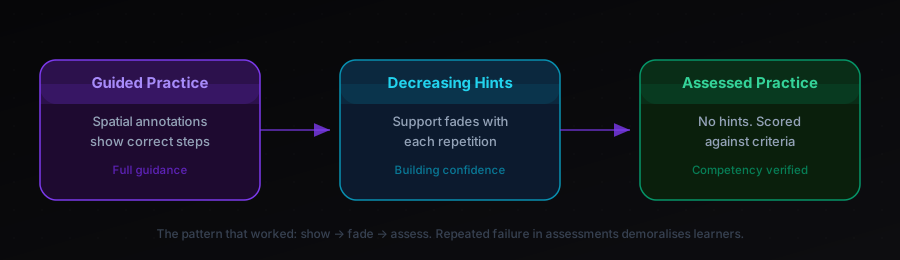
This changes how you structure interactions. In a game, failure is a learning mechanism. In a training sim, repeated failure is demoralizing and erodes trust in the system.
The pattern that worked best: guided practice first, assessed practice second. Show the learner the correct procedure with spatial annotations, let them repeat it with decreasing guidance, then assess without any hints.
Middleware tools matter
The biggest multiplier on productivity was investing early in Unity editor tools. Clients needed to update content, swap out 3D models, change instructional text, adjust assessment criteria, without touching code.
Building a custom ScriptableObject-driven content pipeline meant the development team could focus on systems while content iteration happened independently. It’s the same principle as a game’s level editor: separate data from logic.
VR training is still an emerging space, and the tooling is maturing rapidly. If you’re coming from game development, the skills transfer directly, it’s the mindset that needs adjusting.